
Nar-Narayan & Lord Vishnu
Badrinath's sanctity is tied to the twin sages Nar and Narayan, said to have performed deep penance here. Hindu tradition holds that Vishnu withdrew to this valley to meditate, seated beneath a berry (badri) tree — giving the site its name.
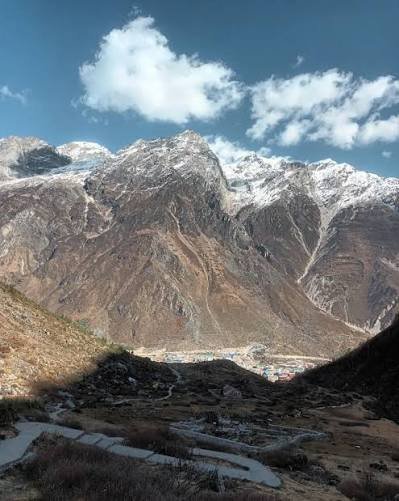
Named for the sages who meditated here
The peaks flanking Badrinath carry the names of Nar and Narayan themselves — a landscape as central to the legend as the temple it surrounds.
Where Ganesha first wrote the Mahabharata
Not far from Badrinath, tucked into the cliffs above Mana village, lies a quiet cave that tradition holds as the birthplace of India's greatest epic. Here, it is said, the sage Ved Vyasa composed the Mahabharata aloud — verse by verse, without pause — and Lord Ganesha, seated before him, broke his own tusk to fashion a pen and set it down in stone. One condition bound them both: Ganesha would write only if Vyasa never paused, and Vyasa would speak only what Ganesha could fully grasp before writing. So began a hundred thousand verses, born of devotion and discipline, in a cave so still you can almost hear it thinking. Pilgrims who walk the short path from Mana still pause here, humbled by the thought that the world's longest poem may have first taken shape on this very mountainside.
Satopanth Glacier — where the Alaknanda is born
High above Mana, past Vasudhara Falls, the Satopanth Glacier feeds the very river that flows past Badrinath's temple steps. One of the most celebrated glaciers in the Garhwal Himalayas, it sits below the Chaukhamba peaks at roughly 4,000 metres — remote, pristine, and rarely seen up close except by serious trekkers. The satellite view below gives a sense of its scale.
Revived by Adi Shankaracharya
The temple's present structure is credited to the 8th–9th century philosopher Adi Shankaracharya, who is said to have recovered the black-stone image of Badrinarayan from the Alaknanda and enshrined it near the Tapt Kund hot spring. The Garhwal kings later expanded and maintained the shrine over the centuries.
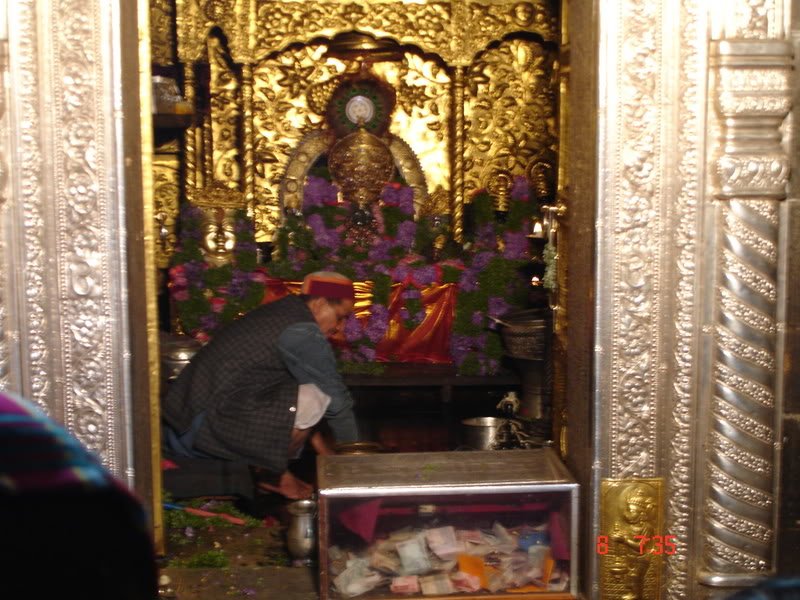
Badrinarayan's black-stone murti
The image enshrined in the sanctum is said to be the very one recovered by Adi Shankaracharya — worshipped here, unmoved, for well over a thousand years.
The hot spring at the gate
A natural hot spring
Pilgrims traditionally bathe in the Tapt Kund's warm sulphur waters before entering the temple — a striking contrast to the cold mountain air around it.
Temple & Rituals
The sanctum, the deity, and the daily darshan schedule.
Read more...